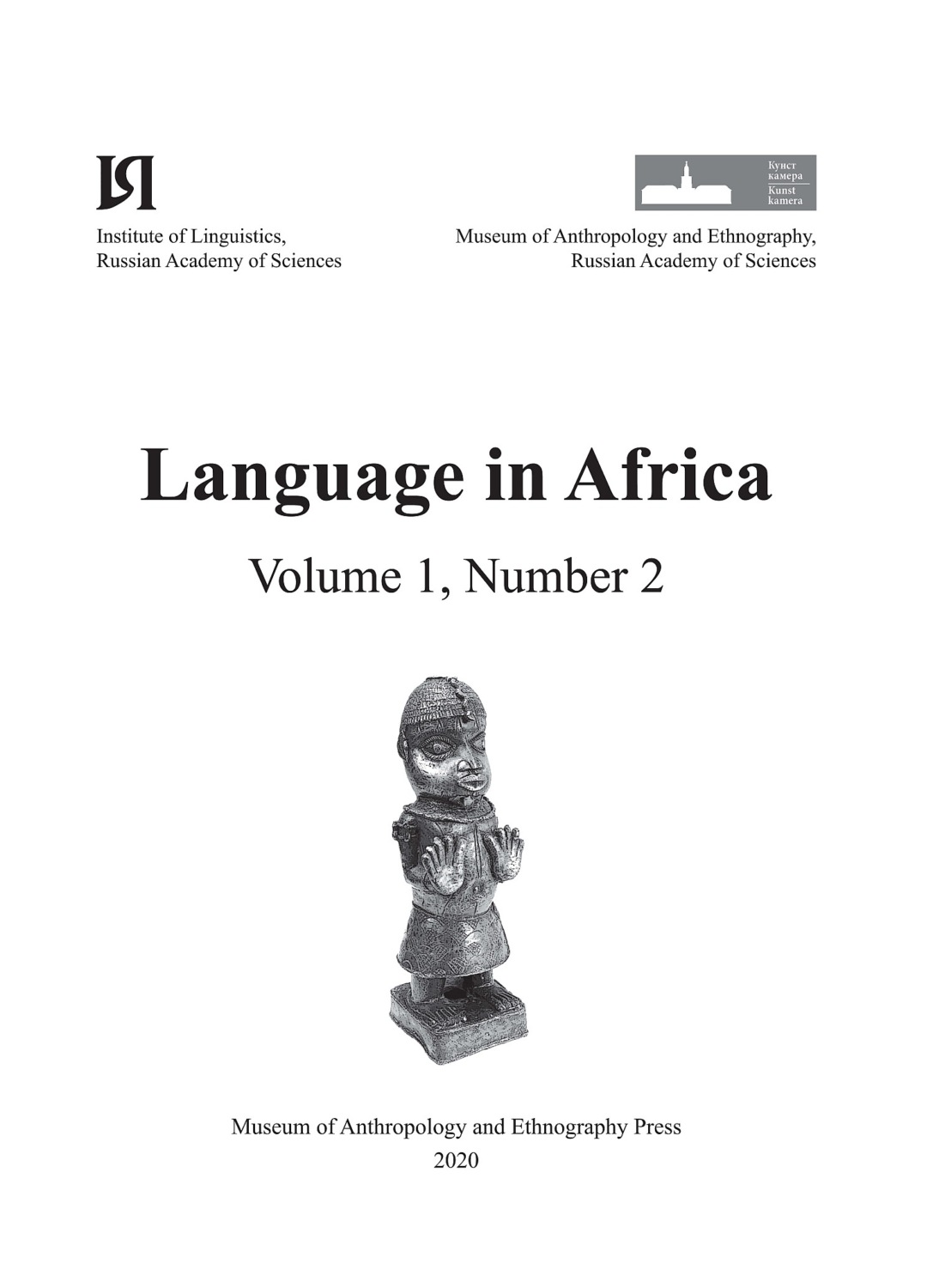
 0+
0+Language in Africa Volume 1, Number 2 (2020)
Где читать или купить
Описание
ASSIMILATION IN DABIDA Abstract: The paper deals with vowel and consonant assimilation in Dabida, Bantu (E74a). While often exhibiting vowel sequences, Dabida nevertheless presents a lot of cases of contact and distant vowel assimilation occurring in verbal roots, stems, suffixes, noun final -a, attributive and presentative demonstratives. Consonant assimilation occurs with nasal prefix [N-] (of noun classes 9/10) homorganic to root initial voiced stops and affricates. All types of assimilation in Dabida belong to the category of morphophonemic rules, but not to phonetic ones. ________________________________________ MAASAI TOPONYMY IN KENYA Abstract: The Maasai are the ethnic group that represents the cultural face of Kenya. This paper discusses placenames that are of Maasai origins and the discussion reveals that the Maasai were keen observers of the natural environment and its content. The Maasai named places based on environmental conditions, physical features, fauna and flora, as well as after social functions. Placenames of Maasai origins reflect the historical migration of the Maasai. From the description, it emerges that through contact with other ethnic languages as well as English, Maasai placenames have been linguistically adapted. The paper concludes that Maasai placenames remain resourceful records of ethnic as well as a nation’s history, a measure of environmental change or degradation. ________________________________________ ЯЗЫК КРЕОЛЬ-МОРИСЬЕН И ЯЗЫКОВАЯ ПОЛИТИКА НА МАВРИКИИ Аннотация: В статье рассматривается процесс формирования полиэтнического и многоязычного населения на Маврикии. Обсуждается формирование и функционирование франкоязычного креольского языка креоль-морисьен, его роль в жизни маврикийского общества. Проблема преобладающей роли креоль-морисьен как языка устного общения и его незначительное использование в качестве письменного языка существенно замедляет его дальнейшее развитие. Отсутствие признания письменных норм языка всем населением острова мешает ему стать общенациональным языком страны. Дальнейшее развитие языка тесно связано с языковой политикой государства, которая в настоящее время четко не сформулирована. REDUCTION OF NOUN CLASS SUFFIXES IN AKEBU Abstract: This paper presents a pilot instrumental study of phonetic reduction of noun class suffixes in Akebu (Kwa, Ghana-Togo mountain, West Africa). Noun class suffixes starting with a glide are regularly perceived as omitted or almost omitted, and therefore full and reduced variants can be distinguished for such nouns. A formant measurement of final parts of full and reduced forms of the same nouns has shown that, first, for a given final part of a noun stem the reduced variant is phonetically close to the corresponding full variant and, second, for a given final part of a noun stem the forms with reduction of different suffixes are phonetically different.
О книге
| Серия | Журнал «Language in Africa» |
|---|---|
| Издательство | Институт языкознания РАН |
| Год издания | 2026 |
| Язык | en |
| Форматы | |
| Возрастное ограничение | 0 |
Похожие книги
 0+
0+ 0+
0+ 0+
0+ 0+
0+ 0+
0+ 0+
0+